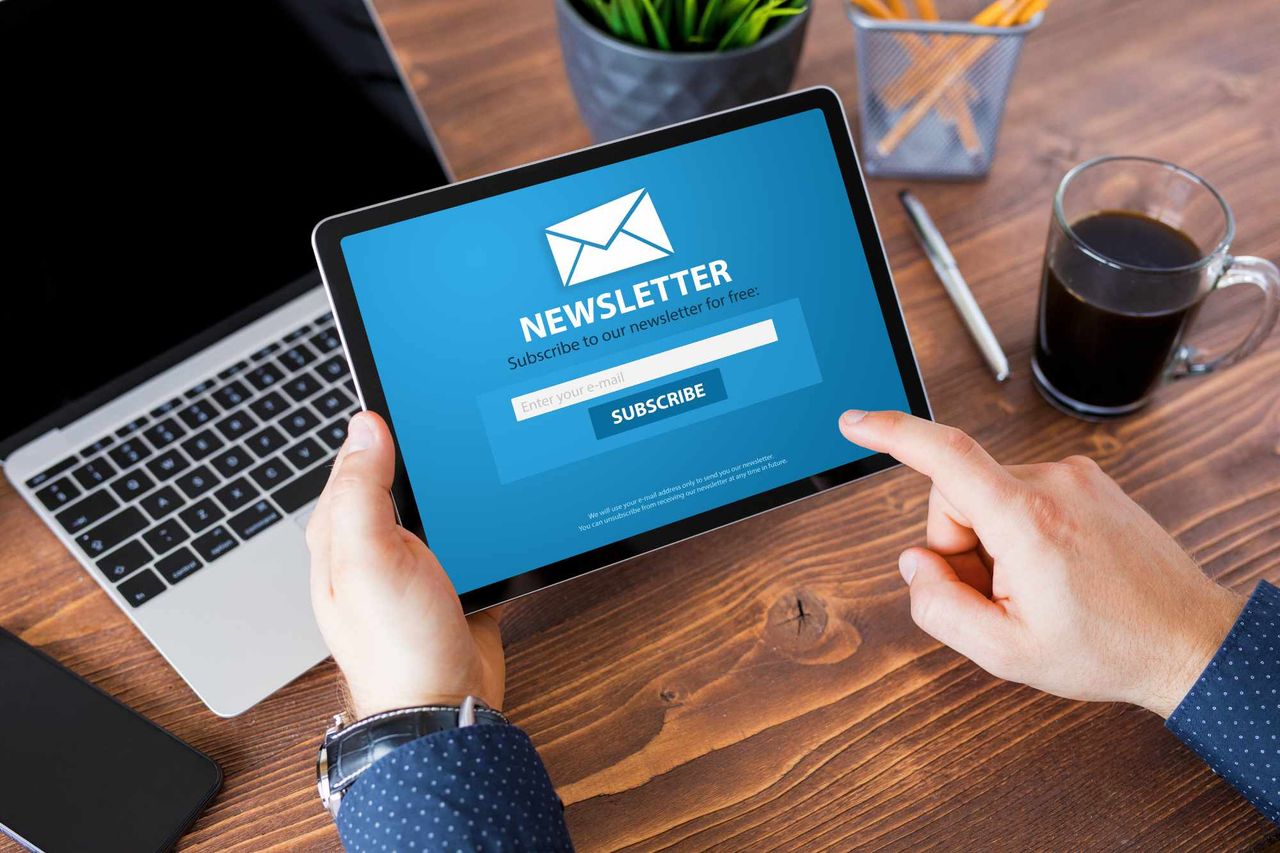
Newsletter for lawyers: Retain clients, increase referrals

Contents

Most law firms invest heavily in acquiring new clients – and almost nothing in retaining existing ones. Yet industry data shows that it is up to five times more expensive to acquire a new client than to retain an existing one. A professionally designed newsletter is the most effective tool for staying top of mind after a case is closed – and for being the first point of contact for the next legal issue.

Newsletter for lawyers

This guide explains how to create a legally compliant law firm newsletter, what content works, which tools are suitable for lawyers – and how to measure concrete results. For integration into your overall strategy, also read our guide. Social Media for Lawyers.

Why a newsletter works for lawyers

Email is the most direct digital channel a law firm controls. Unlike social media reach or Google rankings, an email list doesn't depend on algorithms or platform decisions. The list belongs to you.

The figures support this: In the B2B sector – and law firms often operate precisely in this area – open rates regularly range between 25 and 35 percent. By comparison, organic reach on LinkedIn averages 3–5 percent of followers, and even less on Facebook. A well-maintained newsletter, therefore, reaches many times the number of people actively searching for your law firm.

The crucial difference to social media Those who subscribe to your newsletter have actively consented – this is intentional, not a random encounter in their feed. This quality of attention translates directly into higher conversion rates in the next contact.

Legal basis: GDPR and Section 7 of the German Unfair Competition Act (UWG) for law firm newsletters

This section is particularly relevant for lawyers: A newsletter sent without legally compliant consent violates Section 7 Paragraph 2 No. 3 of the German Unfair Competition Act (UWG) – and can lead to cease-and-desist letters and the risk of legal costs. This is an unnecessary risk for a law firm that sets its own legal standards.

Double opt-in – the only legally compliant option

The double opt-in procedure is mandatory: The interested party enters their email address, receives a confirmation email, and actively clicks on the activation link. Only then is the consent legally valid. Simple registration without confirmation ("single opt-in") is considered insufficiently verifiable in Germany.

What is allowed with existing clients

Section 7 paragraph 3 of the German Unfair Competition Act (UWG) provides an exception: Existing clients who have provided their email address within the scope of the client relationship may be contacted by email for similar services – provided that:

  • When collecting the email address, the possibility was clearly pointed out to,
  • the client did not object,
  • Every promotional email contains an easy unsubscribe option.

Practical recommendation: Actively obtain written consent from existing clients as well – via a double opt-in form or a brief inquiry during the client meeting. This is more legally compliant and simultaneously builds a well-maintained client list.

GDPR: What applies to the technical implementation

The following points must be ensured:

  • Conclude a data processing agreement (DPA) with the chosen email tool.
  • The privacy policy contains information about newsletters and email service providers.
  • Unsubscribe option in every email (obligation according to § 7 para. 3 no. 4 UWG)
  • Storage of consents with timestamp and IP address (proof in case of dispute)
  • US-based tools (e.g., Mailchimp) only with a valid data processing agreement and verified data transfer.
Note for lawyers Lawyers, as members of the legal profession bound by confidentiality, are particularly vulnerable. Ensure that newsletter content does not contain any client-specific information – even anonymized versions – if it could allow for inferences to be drawn.

Have your newsletter set up in a legally compliant manner

OMmatic sets up your law firm newsletter in a technically correct manner – GDPR-compliant, with double opt-in and full data processing agreement.

The right tools: Email marketing platforms for law firms

For lawyers, two priorities apply when choosing a tool: GDPR compliance and ease of use. The following overview evaluates the most common platforms from a law firm perspective:

ToolFree entryEvaluationSpecial features for law firms
Brevo (formerly Sendinblue)Free for up to 300 emails/day★★★★☆EU servers, GDPR-compliant, good automation, German interface
CleverReachFree for up to 250 recipients / 1,000 emails/month.★★★★☆German company, GDPR compliant, easy to use
MailchimpFree for up to 500 recipients / 1,000 emails/month.★★★☆☆US servers – GDPR risk without data processing agreement (DPA) review; not the first choice
ActiveCampaignFrom about €15/month.★★★★★CRM integration, powerful automation – for growing law firms
ClickTipFrom approximately €27/month.★★★★☆German company, GDPR-compliant, strong tagging system

Recommendation: For most sole practitioners and smaller partnerships, Brevo or CleverReach The right starting point – EU server, easy operation, free start. ActiveCampaign is recommended for law firms that want to combine newsletters with CRM integration and automated follow-up emails.

Building an email list: Where subscribers come from

The list is the newsletter's most valuable asset. Without a well-maintained, qualified list, even the best tool is useless. Law firms have several sources:

Activate existing clients

The simplest starting point: Write your existing clients a personal email with a concrete promise of benefit – not „sign up for our newsletter“, but „you will receive the most important changes in labor law that could be relevant to your business once a month“. The difference in subscription behavior is significant.

Website form with lead magnet

A registration form without any reward converts poorly. A well-chosen lead magnet – a short checklist, a concise guide, or a structured FAQ document on the relevant legal area – can significantly increase the registration rate. Important: The lead magnet must offer genuine informational value, not be a sales message disguised as a guide.

Initial personal contact

The initial consultation is the ideal time: Actively ask at the end. "I send out brief monthly updates on relevant changes in family law – may I forward these to you?" Anyone who agrees to this is a high-value subscriber.

What law firm newsletter subscribers want to read

The most common mistake: Law firms write newsletters about themselves – new partners, new offices, cases won. Subscribers aren't interested in that. What they want to read is content that helps them in their own situation.

Topic formats that have proven to work well in the past:

  • „"This is what you need to know now" – Brief analysis of a legal change affecting the target group
  • Checklist – practical, it is saved and forwarded
  • Verdict of the Month – A relevant ruling, explained in 5 sentences
  • Common mistakes – specific, relevant, positions you as experts
  • Anonymized case sketch – shows how you solved a problem without disclosing client data

A complete annual content plan for law firm newsletters:

MonthTheme ideaWhy it works
JanuaryYear in Review: The most important legal changesDemonstrates expertise, appears curated
FebruaryCommon mistakes in the field of [law]High relevance for clients
MarchVerdict of the month: What does this mean for you?Timeliness and classification
AprilChecklist: What to do in [frequent situation]?Directly useful, shared
MayFAQ: Your 5 most frequently asked questionsClient-oriented, low barrier to entry
JuneIntroducing the law firm staff / News from the law firmHumanity, trust
JulySummer tip: [Legal topic with seasonal relevance]Relevant and memorable
AugustGuest article or expert interviewReach, credibility
SeptemberNew laws from autumn: What's changing?Timing-relevant, will be forwarded
OctoberCase study (anonymized): How we helpedSocial validation, specifically
NovemberYear-end check: What should you take care of before December?Action trigger
DecemberPersonal year-end message + outlookRelationship building

Subject lines: The only text that determines success or failure

Open rate hinges on the subject line, not the content or design. If someone doesn't open the email, they won't read it. Here are some principles that work particularly well in B2B contexts and for legal topics:

principleExampleWhy it works
Concrete benefits„"3 changes in employment law that will affect your next conversation"“Promises directly usable content
Number or time indication„"New Federal Court of Justice ruling from February – what this means for landlords"“Timeliness + Relevance to target group
Question with self-interest„"Do your employees know what the rules are regarding termination?"“Activates a sense of responsibility
Warning / Risk„"This mistake costs companies money every day."“Fear of loss outweighs hope of gain
Simple announcement„"Your monthly legal update – April 2026"“For loyal subscribers: Habit and recognition

Technical rule of thumb: Subject lines between 40 and 60 characters are displayed in full in most email clients. Shorter isn't always better – but too long reduces visibility.

Measurability: Which KPIs really count?

A newsletter without key performance indicators (KPIs) is an unjustified cost. With the right KPIs, it becomes a manageable tool. The following table shows benchmark values for law firm newsletters:

KPIGood (law firms)Need for optimizationAdjustment screw
Open Rate25–35 %< 20 %Optimize subject line, sender name, and delivery time
Click-to-Open Rate (CTOR)15–25 %< 10 %Make content more relevant, place CTAs more prominently
Disenrollment rate< 0.5 %> 1 %Review content: too promotional, too infrequent, irrelevant segmentation
Bounce rate (Soft + Hard)< 3 %> 5 %Clean up the list, consistently implement double opt-in.
Conversion (Newsletter request)1–3 %< 0.5 %Optimize CTA and offer entry in the newsletter

Practical example: Trixie Hoferichter law firm

The law firm Trixie Hoferichter, specializing in employment law for employers, launched its newsletter with a streamlined list of 180 existing clients. The goal was not to reach a wider audience, but to reactivate previously concluded cases.

Proceed:

  • Monthly newsletter with one theme: Judgment of the Month + 2 practically relevant conclusions
  • Brevo as a platform, data processing agreement concluded, GDPR-compliant double opt-in for new members
  • Subject lines should be consistently in the format "[Month]: [specific topic]"„
  • CTA at the end: "Any questions? I'd be happy to set aside 15 minutes."„

Result after 12 months: Short-term, individual engagements evolved into long-term consulting relationships with employers. The newsletter became the central tool for regularly sharing expertise and maintaining a visible presence. Full case study: ommatic.de/erfolge/kanzlei-trixie-hoferichter/.

Newsletter setup for your law firm – including GDPR check

OMmatic fully sets up your newsletter channel: tool selection, data processing agreement (DPA), double opt-in, first template and content strategy for 12 months.

Frequently Asked Questions

How often should a law firm send out a newsletter?

Once a month is the recommended starting point. Weekly newsletters require significant resources and are only worthwhile if they contain sufficient relevant content. For most law firms, a monthly schedule is realistic and adequate – consistency is key. Those who send newsletters irregularly and without a discernible pattern will quickly lose subscribers.

Am I allowed to simply send emails to my existing clients?

Only under certain conditions – and most safely with explicit consent. Section 7, paragraph 3 of the German Unfair Competition Act (UWG) permits advertising via email to existing clients under defined conditions. In practice, however, we recommend actively obtaining double opt-in consent – this is more legally compliant, documentable, and simultaneously allows you to build a well-managed mailing list.

What happens if someone unsubscribes from the newsletter?

Immediate dismissal – that is a legal obligation. Every newsletter email must contain an unsubscribe link – after clicking it, the person must be immediately and completely removed from the mailing list. Reactivation without renewed consent is not permitted. Professional tools like Brevo or CleverReach manage this automatically.

What content is most effective for a law firm newsletter?

Practical analysis of current legal changes and specific recommendations for action. Content that performs best is directly related to the professional or personal situation of subscribers and offers them immediate benefit – for example, a brief explanation of a Federal Court of Justice (BGH) ruling with a concrete conclusion for the reader. Generic self-promotion or mere law firm news leads to high unsubscribe rates.

How large does the list need to be for a newsletter to be worthwhile?

A measurable effect is possible with 50 or more qualified subscribers. Quality trumps quantity: 100 subscribers who actively award mandates or refer clients are more valuable than 1,000 passive contacts. A small, well-maintained list with relevant content delivers better results than a large distribution list with low engagement.

Can artificial intelligence help with newsletter writing?

Yes – as support, not as a replacement. AI tools can help create initial drafts, vary subject lines, or structure content. Important: Legal content must be approved by a lawyer. AI-generated legal statements without expert review can lead to factual errors – and that damages the trust a newsletter is meant to build.

Conclusion

A law firm newsletter is not an optional add-on – it is the most cost-effective way to turn a completed case into a long-term relationship. When set up correctly, it is legally sound, measurable, and surpasses most other marketing channels in its impact.

The requirements are manageable: a GDPR-compliant tool, a consistently maintained list, a monthly schedule, and content that offers genuine value. Our guide explains how to integrate the newsletter into your overall strategy and what role social media plays. Law firm marketing.

Newsletter for your law firm – we handle the setup and strategy

From tool selection and GDPR check to the first finished template: OMmatic sets up your newsletter channel – so you can concentrate on the content.

Read more
The law firm of the future: What modern law firms are doing differently today
Corporate design for law firms: Brand identity that builds trust
Google Business Profile for Lawyers: Systematically Build Local Visibility
Contents