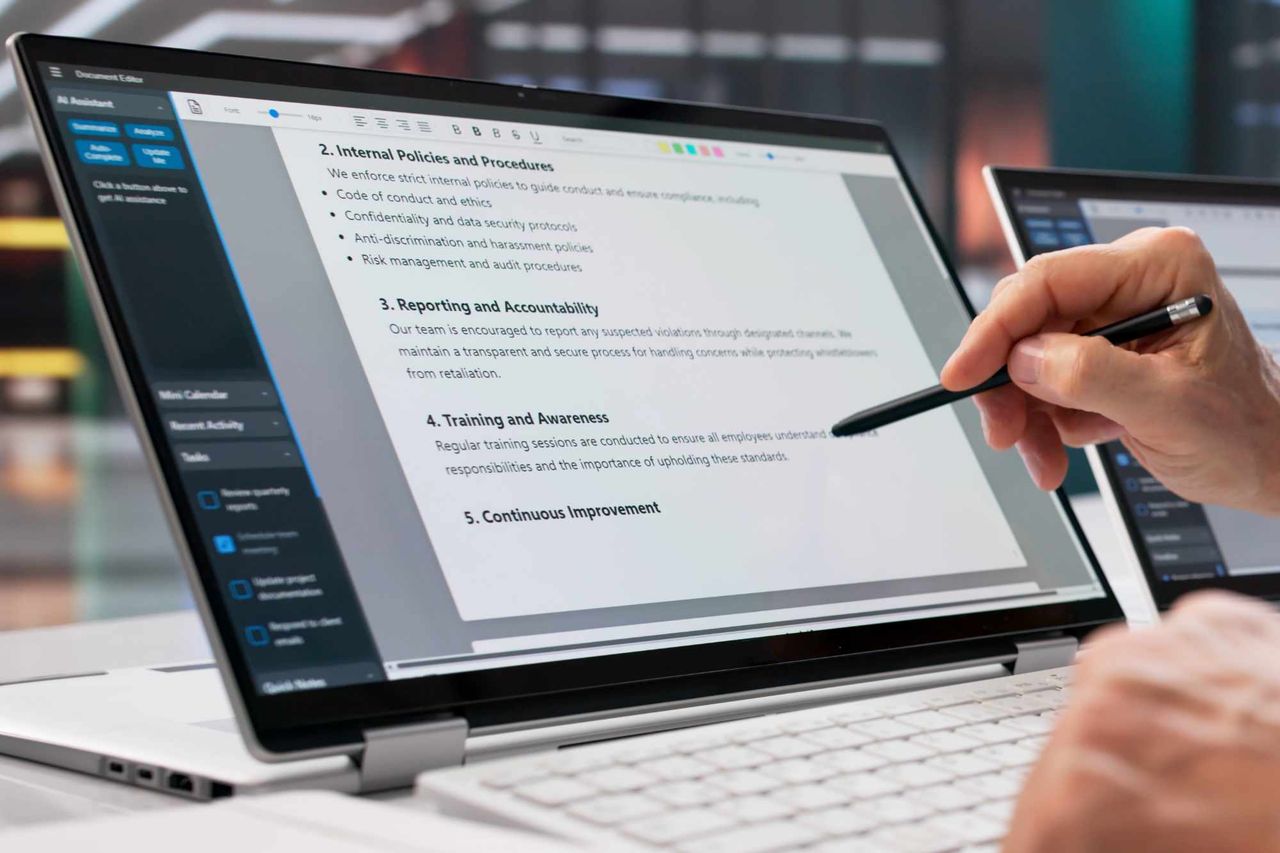
In today's digital world, a professional website for law firms is no longer optional–it is an absolute must. Yet while many firms have understood that they need to be present online, most make a critical mistake: They treat their website like any other business. This is a costly error.
A website for lawyers is something special. It must not only be aesthetically appealing–it must build trust, comply with legal requirements, demonstrate your expertise, and convince potential clients that your firm is the right choice. At the same time, it must be technically optimized, rank on search engines, and convert visitors into concrete inquiries. This is a complex task that requires specialized knowledge.
At OMmatic, we have precisely understood the special requirements that lawyers and law firms have for their digital presence. We have developed specialized web design that not only meets these requirements but exceeds them. Our websites are not just technically optimized and legally compliant–they are true business generators that continuously bring in new mandates.
Your firm deserves a website that brings in mandates
We analyze your current online presence free of charge–and show you concretely what potential you are not yet utilizing today.
Why most law firm websites fail
Let me start with an uncomfortable truth: Most law firm websites are bad. And I don't just mean bad in design–although that is often the case too–but bad in their overall conception. They were built by agencies that have no specialization in the legal industry. They were created with standard templates that look the same for every industry. They were built by lawyers themselves who are experts in their legal field but not in web design and conversion optimization. The result is predictable: a website that doesn't work.
Look at the statistics:
- Over 80 percent of all client searches begin online–on Google, in directories, on social media
- If your website doesn't rank on the first page of Google, you won't be found
- If your website appears unprofessional, the potential client will immediately click away
- If your website loads slowly, they won't wait–the average bounce rate increases by 7% per second of delay(Source: Kissmetrics / Akamai Study (2009)–confirmed by Portent Conversion Study 2022)
- If your website doesn't work on smartphones–and over 62 percent of all traffic worldwide comes from smartphones–they will be frustrated(Source: StatCounter Global Stats, Q4 2024 (global 62.5%; Germany approx. 42-50%))
- If your website is not GDPR-compliant, you risk fines of up to 20 million euros(Source: GDPR Art. 83)
- If your website has no clear call-to-action buttons, visitors won't know how to contact you
The result: You lose mandates to competitors with better websites.
The deeper problem: Wrong message
But there is an even deeper problem. Many law firm websites focus on the wrong message. They talk about the firm–its history, its size, its awards, how long it has existed. But potential clients are not interested in your history. They are interested in their own problem and how you can solve it.
A potential client who comes to your website has concrete questions:
- Can this lawyer help me?
- Can I trust this lawyer?
- How much does it cost?
- How long does it take?
- What results can I expect?
- How does the process work?
- What is the next step?
If your website doesn't answer these questions, you won't convert. Instead, the visitor will go to a competitor whose website does answer these questions.
The anatomy of a successful law firm website
A successful website for lawyers consists of several interlocking components. Each of these components fulfills a specific function, and only when all work together does a website emerge that truly works. Let me go through these components in detail.
1. Trust signals–The psychological foundation
Clients must trust your firm. But trust is not created through empty promises–it is created through concrete trust signals. This is psychologically important. People make decisions based on emotions, not just facts. And trust is an emotion.
This starts with professional photos of your team. Not stock photos of smiling people in suits–real photos of your real lawyers. Potential clients want to know who they are dealing with. They want to see a real face, not a generic illustration. This is not superficial–it is psychologically important. People trust faces more than text. According to HubSpot, landing pages with authentic team photos convert up to 45% better than pages with stock photos. A/B tests show: Pages with real person photos generate 48% more contact inquiries than those with placeholder icons.(Sources: HubSpot, cited in Growbo (2025); VWO Human Landing Page Conversion Study)
Then you need a clear presentation of your qualifications and experience:
- How long have you been practicing? (Longer = more experience)
- In which areas do you have special expertise? (Specialization)
- Which cases have you successfully closed? (Proven track record)
- What is your success rate? (Concrete numbers)
- Which awards have you received? (External validation)
- Are you a certified specialist lawyer? (Official recognition)
- Are you a member of professional associations? (Professional affiliation)
These are not just facts – these are trust signals that tell the potential client: This lawyer knows what they're talking about.
Client reviews and testimonials play a crucial role. Real words from real clients carry more weight than any self-promotion. When a former client says: This lawyer helped me win my case and was professional and friendly throughout – that is convincing. That is authentic. That builds trust. According to Trustmary, conversion rates increase by up to 67% when visitors see client reviews on the website. Every 0.1-point improvement in average star rating increases the conversion rate of a Google profile by 4.4%.(Sources: Trustmary eCommerce Study (2024); SOCi Local Business Conversion Study (2022))
Certifications and awards signal that your work is recognized by other professionals. If you are a certified specialist lawyer, this should be displayed prominently. If you are a member of professional associations, this should be visible. If you have won awards, this should be mentioned.
And transparent fee structures signal that you have nothing to hide. When you clearly explain your fee structure – whether hourly rates, flat fees, or contingency fees – you reduce uncertainty and increase trust.
2. User Experience – The Functional Backbone
A website can look beautiful – but if the user experience is poor, you lose clients. That is a harsh reality. A beautiful website that doesn't function is worse than no website at all.
Navigation must be intuitive. If someone comes to your website and doesn't find what they're looking for within 3 clicks, they will leave. This is not theory – this is practice. The average time spent on a website is only 2-3 minutes. In that time, the visitor must understand who you are, what you do, and how to contact you.
Your navigation structure should be logical:
- Home – Who are you? What do you do?
- About Us – More about your firm, your team, your values
- Services/Practice Areas – What can you offer?
- About Me – Detailed information about you as a lawyer
- Blog/Resources – Valuable content for your target audience
- Contact – Multiple contact options
- Legal Notice/Privacy Policy – Legally required
Loading times must be fast. Every second of delay costs you conversions. The data is clear:
- 1 second delay = 7% bounce rate (Pingdom) / 7% conversion loss (Akamai/Kissmetrics)
- 1 to 3 seconds = bounce probability increases by 32% (Google 2018)
- 5 seconds loading time = bounce rate increases to 38% (Pingdom)
- 53% of all mobile users abandon pages that take longer than 3 seconds to load (Google 2018)
(Sources: Pingdom Website Speed Report; Google Mobile Speed Study (2018); Akamai (2009); Kissmetrics)
These are not small numbers – these are massive losses. A website that takes 5 seconds to load loses a large portion of its visitors.
The website must function optimally on all devices – desktop, tablet, smartphone. According to StatCounter, globally over 62 percent of all traffic comes from smartphones (as of Q4 2024). If your website doesn't work on smartphones, you lose the majority of your visitors. This is not optional – this is essential.(Source: StatCounter Global Stats, Q4 2024)
Contact must be simple:
- A clear contact form with few fields (name, email, phone, message)
- A prominent phone number
- An email address
- Ideally a messaging system (WhatsApp, chat)
- An appointment booking system for consultations
The easier you make it for visitors to contact you, the more inquiries you will receive.
And you need clear call-to-action buttons that guide the visitor to the next step. Not hidden, not small – prominent and compelling. Contact Us, Free Consultation, Schedule Appointment – these should be visible multiple times on the page.
3. Search Engine Optimization – The Visibility
Your website must be found. That means: You must rank on Google. And that is not trivial. It requires several things working together.
First: Technical Optimization. These are the fundamentals Google needs to understand and rank your website:
- Fast loading times (under 3 seconds)
- Mobile friendliness (responsive design)
- Secure connection (HTTPS with SSL certificate)
- Clean, semantic HTML code
- Structured data (Schema Markup) – especially LegalService schema for law firms
- XML sitemap
- Robots.txt file
- Canonical tags
Second: Content Optimization. Your text must contain the keywords your target clients are searching for – but naturally and meaningfully. If someone searches for employment lawyer in Munich, your website should contain these terms, but in a natural context. Not artificially inserted, but organically integrated into the text.
Third: Internal Linking. Your pages should be connected to each other with meaningful anchor texts. This helps Google understand your website structure and concentrate authority on your most important pages.
Fourth: High-Quality Content. Google favors websites with valuable, unique content. If your website only offers superficial information, Google will not rank you. But if your website offers in-depth, valuable information, Google will reward you. Google doesn't just rank by keywords – it ranks by value and relevance.
4. Security and Data Protection – The Legal Obligation
For lawyers, this is non-negotiable. This is not optional – this is mandatory.
SSL encryption (HTTPS) is mandatory – your website must display with a green padlock. This signals to visitors that the connection is secure. Without HTTPS, Google ranks your website lower and displays a warning.
GDPR compliance is mandatory – you must know how to handle and protect data. This means:
- No sharing of data with third parties without consent
- A clear privacy policy that explains how you process data
- A contact form that transmits data securely
- A cookie banner that obtains visitor consent
- Secure data transmission – contact forms must be encrypted
- A complete privacy policy
- A correct imprint
Legal basis: GDPR Art. 83 – fines up to 20 million euros or 4% of global annual revenue
Anyone who is negligent here risks not only fines – they risk their reputation. If your website is hacked or data is stolen, it's a disaster. That's why security is not optional – it's essential.
5. Conversion Optimization – The Business Goal
In the end, it's about one thing: turning visitors into clients. That is the goal of your website. Not beauty, not elegance – conversions.
This requires a clear value proposition – why should someone hire you and not another lawyer? This should be immediately clear on your homepage. Not hidden, not subtle – clear and obvious.
It requires compelling copy that understands your target clients' problems and offers solutions. Not generic text – specific text that shows you understand your target audience. An employment lawyer should write about employment law problems, not general legal problems.
It requires strategically placed call-to-action buttons. Contact us, Free consultation, Schedule appointment – these should be visible multiple times on the page. Not just at the end – also in the middle, after important sections.
It requires simple contact forms. The fewer fields, the better. Ideally: name, email, phone, brief message. Not 10 fields that deter visitors. Studies show that each additional form field reduces conversion rate by 3-5%.
It requires a promise: If you contact me, I will help you. This should be clearly communicated. Free initial consultation, quick response, confidentiality guaranteed – these promises reduce barriers.
Ready for a website that truly works?
In a 30-minute conversation, we'll show you how your new website can go live in 6-10 weeks.
Discuss now without obligation
Corporate Design and Branding for Law Firms
A consistent corporate design is not just beautiful – it's strategically important. Your logo, your color palette, your typography, your visual language – these elements together create a visual identity that distinguishes your law firm from all others.
A strong corporate design differentiates you from your competitors. If you have a generic website that looks just like 100 other law firm websites, you won't stand out. But if you have a unique, consistent design, you will stand out.
It creates recognition value – when someone sees your colors, they think of your law firm. This is psychologically powerful. It conveys professionalism and trustworthiness – before the potential client has even read a word. A professional design says: This law firm is reputable, competent and trustworthy.
It measurably increases conversion rate. Websites with consistent corporate design demonstrably convert better than generic websites – the exact effect depends on industry and implementation.
The OMmatic Web Design Process: From Idea to Reality
Our process is structured, transparent, and focused on your results. We don't start with design – we start with strategy.
Phase 1: Analysis and Strategy
We conduct a thorough analysis of your law firm:
- Who are you? What is your specialization?
- What do you do? What services do you offer?
- Who is your target audience? Who do you want to reach?
- What are their problems? How can you solve these problems?
- How can you differentiate yourself? What makes you unique?
Then we analyze your competitors:
- Who are your competitors? Who ranks for your keywords?
- What do they do well? What can we learn from them?
- What do they do poorly? Where can we be better?
- How can we differentiate you? Where is your opportunity?
Then we analyze the current market:
- What works in your industry? What are the best practices?
- What trends exist? What should we pay attention to?
- What opportunities exist? Where can we grow?
Then we define clear objectives:
- What should the website achieve? Which KPIs are important?
- How many inquiries per month? What conversion rate?
- Which rankings do we want to achieve? In what timeframe?
Phase 2: Concept and Design
In this phase, we create wireframes and design mockups. You'll see exactly what your website will look like before we begin development. We create multiple variants so you can choose.
Your feedback is important to us – we adjust until you are 100 percent satisfied. We don't just focus on aesthetics – we focus on functionality. Every element has a purpose. Every color, every font, every image is strategically chosen.
Phase 3: Development and Implementation
Development and implementation is technically demanding. We use modern technologies like WordPress to create a website that is fast, secure, and scalable.
We not only optimize for search engines, but also implement all security measures and verify compliance with all relevant laws and regulations:
- SSL encryption
- GDPR compliance
- Secure contact forms
- Backup systems
- Monitoring and updates
Phase 4: Testing and Launch
Before launch, we conduct comprehensive testing:
- Testing on all devices – desktop, tablet, smartphone
- Testing all functions – contact forms, links, buttons
- Optimizing performance – loading times, images, code
- Reviewing all SEO factors
- Security testing
Then your website goes live. But we don't stop there – we provide continuous support and optimization. We monitor performance, analyze data, identify improvement opportunities, and implement them. Case Study: Practical Example from Our Work
A concrete example shows how transformative a professional website relaunch can be. A law firm had practically no digital visibility – the only advertising was a sign on the building facade. There was no professional online presence and no strategy for client acquisition in the digital space.
We developed a holistic strategy:
- Complete website relaunch with focus on conversion, trust, and expertise
- Mobile optimization and fast loading times
- SEO optimization for relevant keywords
- Conversion focus with clear call-to-action buttons
- Target audience analysis and website customization
- Testimonials and trust signals
- Google Business Profile optimization
The result was impressive:
Independence from individual marketing channels
From practically zero to 130 qualified inquiries per week
Continuous growth over 3 years
Stable demand across multiple channels
This is not theory – this is practice. This is what specialized web design for lawyers can achieve.
What could 130 inquiries per week mean for your law firm?
That's exactly what we achieved for Kanzlei Motzenbäcker-Adam. Let's analyze together what's possible for you.
Discuss now without obligation
Frequently Asked Questions
How long does it take to create a website?
Short answer: 6 to 10 weeks.
The process typically takes 6 to 10 weeks, depending on scope and complexity. We work in an agile manner and keep you informed throughout the entire process. You see regular progress and can provide feedback.
Is the website GDPR-compliant?
Short answer: Yes, without exception.
All our websites fully meet GDPR requirements. This is non-negotiable for us. We implement SSL encryption, secure contact forms, cookie banners, and complete privacy policies. We take data protection seriously.
Can I manage the website myself?
Short answer: Yes – we use WordPress.
We use WordPress, which is easy to manage. We're happy to train you so you can update your website yourself. You can write blog articles, update images, and modify content. You're not dependent on us for small updates.
How much does professional web design cost?
Short answer: Starting at 4,000 euros. Comprehensive projects: 8,000 to 15,000 euros.
Costs vary depending on requirements. Simple websites start at 4,000 euros. Comprehensive websites with SEO optimization and conversion focus cost 8,000 to 15,000 euros. Contact us for a customized quote – we have solutions for different budgets.
How long does it take to see results?
Short answer: Immediately for UX, 3 to 6 months for SEO.
Immediately after launch, you'll see improved user experience and faster loading times. SEO results take 3 to 6 months. You can see conversion improvements within a few weeks.
What distinguishes web design for lawyers from general web design?
Short answer: Legal compliance, industry-specific conversion psychology, and specialized SEO.
Law firm websites are subject to special GDPR and imprint requirements. They must build trust in a sensitive decision-making environment – clients are searching during emergencies or facing complex problems. And they must be optimized for specific legal practice area keywords, which have different search intent than general service keywords.
Your law firm deserves a website that brings in clients
Discuss without obligation now
Conclusion: Your website is your best sales machine
A professional website is an investment in the future of your law firm. It is not just a digital storefront – it is a continuous business generator that brings you new mandates year after year.
While you focus on your cases, your website works for you 24/7. It answers questions, builds trust, and converts potential clients into paying customers. A website with poor design costs you mandates. A website with good design wins you mandates.
The question is not whether you need a website – the question is how good your website will be.