
From the January 1, 2025 Lawyers must also... E-invoicing obligation in the B2B sector Please note: This new regulation requires technical adjustments in all law firms to comply with legal requirements.
The legal profession was recently relieved of some burdens by the abolition of the written form requirement for lawyers' invoices under Section 10 of the German Lawyers' Fees Act (RVG). However, the introduction of electronic invoicing under Section 14 of the German Value Added Tax Act (UStG) is now imminent. This affects all lawyers, but with varying implementation deadlines and consequences depending on the specific case.
New regulations for issuing electronic invoices in the B2B sector
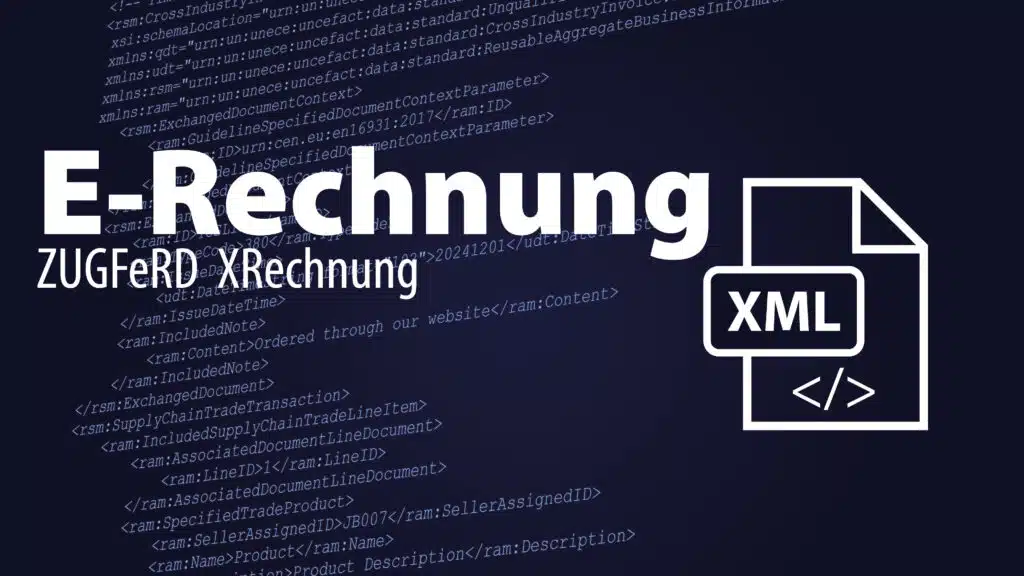
The obligation to use e-invoicing affects companies in the B2B sector and requires technical adjustments in all law firms.
The Growth Opportunities Act, The law published in the Federal Law Gazette 2024 I No. 108 of March 27, 2024, introduces a significant change in the area of invoicing. From January 1, 2025, the Obligation to issue electronic invoices According to Section 14 of the German VAT Act (UStG), this provision has also been extended to business transactions in the B2B sector. This regulation, which previously only applied to public sector clients, is part of efforts to simplify and modernize tax administration.
A key innovation is that a distinction will now be made between electronic and other types of invoices. Electronic invoices must be in a structured Invoices must be issued, transmitted, and received in electronic format, enabling automated processing. Other invoices, however, are not included. other electronic formats or on Paper, including PDF documents, to the other invoices. However, the latter do not meet the strict requirements for an electronic invoice and are therefore subject to further regulations.
This legal amendment aims to... Efficiency and Traceability to improve invoicing processes by encouraging B2B companies to use modern electronic formats. For companies, this means adapting their invoicing processes in a timely manner to comply with legal requirements and avoid potential penalties.
What can I expect and when?
New regulations concerning the issuing and receiving of electronic invoices, affecting lawyers, will come into force on January 1, 2025. There are two key aspects to consider: the receipt and the issuance of electronic invoices.
1. Receiving e-invoices
For lawyers, the following applies from the aforementioned date: Duty, to receive electronic invoices. This regulation applies regardless of the client structure or the company's turnover. Unlike before, there is no transition period, This means that from the first day of 2025, all lawyers must be technically capable of receiving e-invoices. From this point on, companies will also be allowed to send electronic invoices without the recipient's prior consent.
From a technical point of view, it is fundamental to have a Email inbox To provide an email address for receiving e-invoices. Most lawyers already have such email accounts. While a dedicated mailbox for invoices is not strictly necessary, it can offer advantages, particularly for more efficient processing of these invoices. Alternatively, other permissible methods of transmission can be agreed upon.
The definition of legibility for an invoice is changing: In the future, an invoice will be considered legible if it machine-readable is no longer solely determined visually by humans. This requires that the structured dataset, for example in the form of an XML file, suitable for automatic processing systems Some of the approved invoice formats that meet these requirements are XRechnung and the ZUGFeRD format (from version 2.0.1 onwards). The ZUGFeRD format offers a hybrid solution combining a structured data component (XML) and a human-readable component (e.g., PDF) in a single file.
It is recommended to prepare for these changes in good time to ensure that your systems are compatible. In particular, you should check whether your existing office software is suitable for visualizing pure XML files or whether additional tools are needed to meet these requirements.
These preparations are crucial to complying with legal requirements and ensuring the smooth continuation of business operations.
2. Issuing e-invoices
The obligation to exhibit The first issue concerns e-invoices. exclusively the B2B sector within Germany, that is, it only applies to business relationships between companies. For consumers Invoices will remain in conventional form, for example, as a paper invoice or as a PDF document. There are also Transitional periods, This allows sufficient time to thoroughly examine the requirements and develop tailored solutions. Furthermore, the obligation (presumably) does not apply to everyone.
In the first transition phase until the end of 2026 All entrepreneurs can submit invoices for sales from the years 2025 and 2026 either on paper or (if the recipient agrees) in an electronic format that does not comply with the new standards (for example, simple PDF files).
From January 1, 2027 This exception now only applies to businesses whose total revenue in the previous calendar year did not exceed €800,000. All businesses with higher revenues are required to issue e-invoices in accordance with the new requirements from this point forward.
From January 1, 2028 Finally, all entrepreneurs must issue electronic invoices without restriction in accordance with Section 14 Paragraph 1 Sentence 3 of the German VAT Act (UStG nF).
For Small business owners However, nothing changes: They remain unaffected by the engagement for issuing e-invoices (expected) except. The Annual Tax Act 2024 (passed in the Bundestag on October 18, 2024 in its third reading, expected to be passed in the Bundesrat on November 22, 2024) provides for a corresponding exception in accordance with the newly introduced Section 34a of the VAT Implementing Regulation, so that invoices can still be transmitted as conventional invoices, deviating from Section 14 Paragraph 2 Sentence 2 of the VAT Act.
Amendments to Section 10 of the German Lawyers' Fees Act (RVG) regarding electronic invoices
The abolition of the written form requirement eliminates a potential conflict of form; text form suffices. A handwritten signature is therefore no longer required. The mandatory information requirements of Section 10 Paragraph 2 of the German Lawyers' Fees Act (RVG) should also not pose an obstacle, as electronic invoices offer options for supplementary information in addition to the purely VAT-relevant data.
Conclusion:
Electronic invoices do not require a specific format. Lawyers should therefore be prepared for this. various permissible formats This could be implemented in law firms. Software providers for law firm management are expected to offer corresponding updates, as is already the case with many common providers. Accounting programs are also likely to offer similar functions.
In addition, some companies offer specialized solutions for creating and receiving electronic invoices. Particular attention must be paid to attorney-client privilege and compliance with Section 43e of the German Federal Lawyers' Act (BRAO) and Section 2 of the German Federal Lawyers' Professional Code of Conduct (BORA).
The obligation to issue e-invoices and the associated [unclear] Digitization of workflows They also offer opportunities. Particularly in times of skilled labor shortages, valuable resources can be freed up. Electronic invoices not only save paper and postage, but also enable automated processing, greater flexibility, faster payment processes, and reduce the likelihood of errors compared to manual data processing and transmission, leading to a reduction in personnel costs.
The further development of this area should therefore be closely monitored.
Contact us now
If you have any further questions about switching to electronic invoices or require our support, please do not hesitate to contact us. Our team is happy to discuss your individual requirements and develop tailored solutions. Benefit from our many years of experience and expertise in legal consulting and digital transformation.